We are available for bookings, for weddings, birthdays parties, garden parties — anywhere you want the sound of true traditional Irish music!
Straight from the Jug
Straight from the Jug are…
Uillean piper, Dominic Henderson
Dominic Henderson is a renowned uilleann piper and whistle player from North London who earned his stripes as a teenager playing at sessions, before taking his talents further afield, qualifying for the All-Ireland uilleann pipe final in 2007. He subsequently co-founded TEYR, releasing two studio albums.
Dominic has a keen interest in traditional piping, but his strength lies in a unique modern uilleann piping style which blends respect for the tradition with his own musical experimentation.
Fiddler, Bradon Smith
Bradon Smith is a respected fiddler player and fiddle teacher based in Bristol, UK. Classically trained but growing up in a folk family, Bradon has played folk fiddle since the age of 5. He is a well-known fiddle player on the Bristol, Bath, and London session scene.
Bradon also plays fiddle with The Sunny Banks, a four piece band playing pure-drop Irish folk music.
He plays regularly for ceilidhs with The Sunny Banks, as well as being a sought after fiddle player for other ceilidh bands in the South of England and beyond.
Forged in London, formed in Bristol
Fiddle and uilleann pipes has for a long time been one of my favourite duo combinations in Irish traditional music. They just seem to complement each other so well, blending together but also filling in the gaps left by the other instrument. I love playing with good uilleann pipe players. They also both provide a lovely drone backdrop for songs.
Years ago, Dominic Henderson and I used to play together regularly in South London, often to be found in the front window of the grand old pub The Antelope in Tooting on a Sunday afternoon (and then, quite likely, off to sessions at the Howl at the Moon in Hoxton, and then on to The Lamb in Camden!).
I moved away from London and we had fewer chances to play together. But when Dom moved over to the South West we began playing together again — re-finding our love of driving rhythmic tunes, as well as the opportunities of playing some slower reels and airs together. We added songs for two voices to our repertoire, and Straight from the Jug was born.
This is a lovely Irish jig called Timmy Clifford’s jig, or sometimes called Micho Russell’s jig. I learned it from the playing of the Kerry fiddle player, Gerry Harrington. As far as I can work out Timmy Clifford was a box player, also from Kerry, who emigrated to Chicago. This jig might be one of his compositions, or maybe a traditional tune which he brought with him to America and which became associated with him.
We also often play it now in our Shanvaghera set list with two other fine jigs, The Yellow Wattle and Bogs of Allan.
Timmy Clifford’s jig is a tune that makes good use of the low notes on the fiddle, on the G string. Below you’ll find a playthrough video and a video going through just the melody slowly so you can work it out.
I’ve also transcribed the sheet music for Timmy Clifford’s below, of the setting that I play if you can’t work out the melody from the video.
I’ve had a request from a student to learn a tune called Ashokan Farewell – sheet music, as well as some recordings of mine of this well known tune can be found below.
Do you already play some fiddle? but maybe you are feeling a little bit stuck in your fiddle playing? or you’d like to take your playing further?
Looking for … that authentic flowing Irish fiddle sound?
Feel like your bowing is a little …. rigid or mechanical?
A bit confused by …. how and where to play proper ornamentation?
Struggling to play …. with real rhythm, pulse and lift?
Want to play join in sessions …. but intimidated by the speed?
My Complete Irish Fiddle Courses will transform your playing.
Ashokan Farewell, a lovely waltz written by the American fiddler Jay Ungar, is a really popular fiddle tune. Not only in the States, but all around the world. It’s a sweet (perhaps bittersweet) waltz, normally played at a steady tempo with an emphasis on the melody and a good tone.
Jay wrote the tune at the end of one of his Ashokan Fiddle and Dance camps, as a bittersweet lament for the end of the event. But the tune’s popularity owes a lot to its use on Ken Burns’ landmark PBS documentary The Civil War aired on American television in 1990. Burns had heard the tune on an album by Fiddle Fever – Jay’s band. As a result of that show, Jay explains:
“the tune seems to have taken on a life of its own. Now considered an American “folk” classic, it is played by fiddlers and classical musicians worldwide. In the British Isles, a recording of Ashokan Farewell by Her Majesty’s Royal Marines has remained high on the classical charts for several years”
Indeed, I’ve several time heard the tune referred to as an old American waltz, from the period of the Civil War, presumably a myth that comes from the TV series.
I have included below three different transcriptions of Ashokan Farewell sheet music in pdf format. The notes are the same in each case. The first is just the sheet music, with musical notation alone. The notes here represent just one ‘setting’ – or version – of the tune that I might play, with just a few indicative ornaments and chords included, to give an idea of what you can do with this tune. This is a little more detailed than many of the examples of Ashokan Farewell sheet music that you can find on the internet, and should help you to get a better understanding of how the tune can be played with a little more swing and style.
Fiddlers, want to take your fiddle playing to the next level?
Next, I have provided sheet music for Ashokan Farewell, with numbers and letters below each note to indicate the correct finger and string for each note. For example, a G note on the musical stave — to be played on the D string with the third finger — will have a ‘3’ (3rd finger) and a ‘D’ (the string) written below the note.
Finally, I have included sheet music, with the note names in letters beneath each note.
Hopefully these different versions of the sheet music for Ashokan Farewell will mean that everyone can learn the tune, even if you can’t already read standard musical notation. (And see my page, Can you play the fiddle without reading sheet music?). Feel free to download the sheet music PDF files, but please do attribute the transcriptions to me and link to this site if you use them anywhere.
We’re lucky at the moment to have loads of live Irish music in Bristol and Bath going on every week. There are more Irish sessions right now than I can remember since I came to Bristol 6 years ago. And it isn’t just the amount of live Irish music right now – the consensus is that the quality is improving too.
Photo: @hensonvisuals
As well as the session scene – the grassroots, if you like – there are lots of venues putting on live Irish music gigs too.
I’ve listed below some of the many sessions where you can see live Irish music in Bristol (for free!). And I’ve included some Irish sessions in Bath that I know about too.
I’ve also listed some upcoming Irish music gigs at local venues. These range from small unknown groups to the big names and big venues in Bristol.
Venues and gigs for live Irish music
There are loads of good venues in Bristol. But for folk music the ones to keep an eye on are The Folk House, St George’s Hall, and (for big name acts) the Bristol Beacon. Upcoming Irish gigs of note:
The Star, Fishponds, 1st and 3rd Wednesdays of the month, 8.30pm. This is a very long-standing session, which I run with some of the other members of our band Shanvaghera. The standard is generally very good, but it is a welcoming session.
The Red Monkey, Chandos Road, Bristol. First Sunday of the month, 2pm. This is a new session which I am running with Marick Baxter (flute) and Dominic Henderson (pipes).
The question I get asked often is: ‘Is it hard to learn the fiddle?’. There’s definitely a opinion that it is really hard to learn to play fiddle!
The assumption seems to be that it takes years to start playing tunes. Or even to make a nice clean sound.
But it doesn’t have to take long, or be particularly hard. But it does really help if you get a few things right from the start.
Why do people think it is hard to learn the fiddle?
There are a few things that make learning the fiddle different from some other common instruments. The one that seems to get the most attention, concerns playing in tune. On the piano, when you push down a key, the note sounds in tune.
On a guitar, banjo, mandolin, ukelele and similar instruments there are frets that help you to get the notes in tune. If you place a finger anywhere between the frets, and pluck the string, the note will be in tune.
But on the fiddle fingerboard there are no frets, and no keys. So playing in tune relies on putting your fingers down in the right place on the finger board. Exactly the right place, ideally!
And this does seem to cause people a lot of concern. But in my considerable experience teaching beginners how to play fiddle it isn’t so hard to learn to play the fiddle in tune.
Learning to play in tune
Some beginners (and teachers) like to put stickers on the fingerboard in the spot where the fingers need to be placed. You can even buy sheets that stick on the fingerboard. These can help, I don’t tend to recommend them for 3 reasons.
It means you have to look at your fingers the whole time, which isn’t a good habit to get in to for lots of reasons. Maybe I’ll do a whole post on this!
The placement of your fingers to play in tune is far more precise than stickers can ever be.
Most importantly, it distracts you from the most important thing – using your ears!
In my experience, about 99 out of 100 people can quite quickly learn to play a note and say whether it sounds ‘right’ — or in tune. The rest is about trial and error, constantly listening, constantly correcting your finger position.
Over time you’ll be able to bring your finger down in the right postition more consistently. But even very good fiddle players are constantly making tiny changes based on feedback from their ears. Even if they don’t know it!
What will really help with getting consistent tuning is to learn to keep you hand position approximately the same when playing with each of the different fingers, and on each of the strings. Have a look at my page on How to Play the Fiddle to learn a good starting point for how to hold the fiddle with the left hand.
And getting some advice from a teacher at an early stage is also a great idea to develop a nice relaxed left hand that will help you play in tune right from the start.
Is it hard to learn to make a nice sound on the fiddle?
The other thing that people worry will be hard when learning the fiddle, is making a nice sound. When you first pick up the fiddle, you may worry that it will sound awful. But again, I reckon I can get almost anyone making a nice sound in our first 1 hour lesson.
I’ll write another whole article on making a nice fiddle sound. But the basics are fairly simple:
to start with don’t press down with the bow at all – the weight of the bow will be enough (for now)
keep the bow moving smoothly and fairly quickly
Keep the bow parallel with the bridge, and halfway between the bridge and the end of the fingerboard
So what is hard about learning to play fiddle?
I spend a lot of time with my students talking about bowing technique. So much of your playing quality comes from the bow. The tone, rhythm, phrasing, lilt, pulse are all affected by the bowing technique. So it really pays off to invest time in your practice to thinking just about bowing.
I sometimes say to students: “You can learn to play fiddle tunes in the first year – the bowing is the lifetime project”.
Starting out with a good bow hold is an important place to begin. You want your right hand to be really nice a relaxed. But still have good control of the bow, its movements and its pressure on the string.
It won’t take you too long to get some basic technique, get playing roughly in tune, and get a few beginner fiddle tunes under your belt.
Then the real work begins.
Learning how to play the fiddle isn’t hard. But learning how to play really well, that’s where the work is. But also enormous satisfaction.
And a lot of it starts, I think, with listening. That link will take you to a very small sample of a Irish fiddle players I recommend listening to. It is not comprehensive!
Listen to your favourite players; try to work out what they are doing that you like.
My advice would be: at the beginning, forget about 2 things – ornamentation and speed. You can add the ornaments later, you can build the speed as you progress. Slow and good is better than fast and bad.
Focus instead on what players that you like are doing with emphasis, pulse, phrasing and so on. Can you hear how they are using slurs between notes to create certain patterns?
This kind of listening isn’t casual, it is focussed. And it’s incredibly valuable.
Is it hard to learn the fiddle – no!
The basics of learning to play the fiddle are not necessarily hard. Some help from a good teacher will definitely set you on your way. But you can also teach yourself.
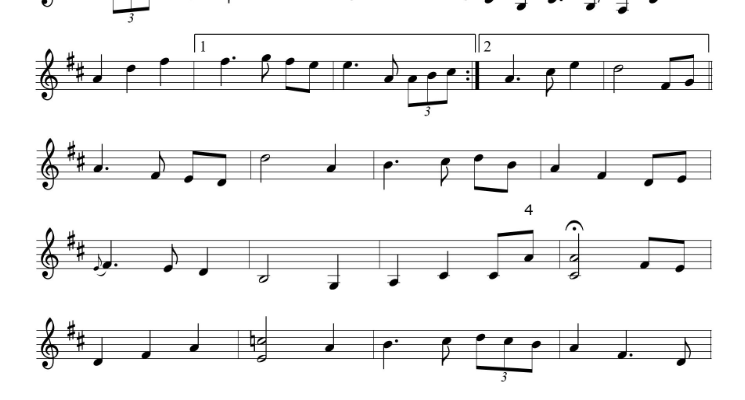
Here’s a beautiful waltz written by Swedish guitarist Roger Tallroth. Normally it is known as Josephine’s Waltz here in England; or I’ve seen it called Josefin’s Waltz in many places.
But it’s name as given by Roger himself is “Johsefins dopvals”. It’s a lovely but simple melody. I believe it was written for his niece’s christening.
Roger is an amazing guitar player, who plays in some unusual – even unique – tunings. This is by far his most well known composition, and is a popular tune in sessions.
I will be making a full video tutorial on Josephine’s Waltz, so do sign up to my newsletter to hear when I post new tutorials.
Josephine’s Waltz (Josefin’s waltz) Sheet Music
I have transcribed the sheet music for Josephine’s (or Josefin’s) waltz – you can see it below. This is how I play the tune, but without any of the drones, chords or ornamentation I would use.
There are different ways that you could write out the sheet music for this tune, since it has a slightly unusual structure. The third and fourth lines on the sheet music are identical – so I could have used a repeat sign. In which case you can think of the tune as having an A part that repeats, a B part that repeats, and a C part that doesn’t (or a kind of ‘coda’). This is how I think of the tune; but it is easier to read on the page when the B part is written out I believe. So that is how I have done it.
Fiddle and uilleann pipes has for a long time been one of my favourite duo combinations in Irish traditional music. They seem to complement each other so well, blending together but also filling in the gaps left by the other instrument. I just love playing with good uilleann pipe players. They also both provide a lovely drone backdrop for songs!
So, I’m thrilled to be playing in this duo project for fiddle and pipes – Straight from the Jug. I’ve teamed up with the great uilleann piper, Dominic Henderson. Years ago, Dom and I used to play together regularly in South London, often to be found in the front window of the grand old pub The Antelope in Tooting on a Sunday afternoon (and then, quite likely, off to sessions at the Howl at the Moon in Hoxton, and then on to The Lamb in Camden!).
When I moved away from London, we had fewer chances to play together. But a couple of years ago, Dom moved over to Bristol and the South West’s hotbed of Irish traditional music(!). So we’ve been playing sessions together again, and re-finding our love of driving rhythmic tunes, as well as the opportunities of playing some slower reels and airs together.
We are available for bookings, for weddings, birthdays parties, garden parties — anywhere you want the sound of true traditional Irish music!
Straight from the Jug – fiddle and pipes
Straight from the Jug are…
Uillean pipes, Dominic Henderson
Dominic Henderson is a renowned uilleann piper and whistle player from North London who earned his stripes as a teenager playing at sessions, before taking his talents further afield, qualifying for the All-Ireland uilleann pipe final in 2007.
Dominic has a keen interest in traditional piping, but his strength lies in a unique modern uilleann piping style which blends respect for the tradition with his own musical experimentation.
Fiddle, Bradon Smith
Bradon Smith is a respected fiddler player and fiddle teacher based in Bristol, UK. Classically trained but growing up in a folk family, Bradon has played folk fiddle since the age of 5. He is a well-known fiddle player on the Bristol, Bath, and London session scene.
Bradon also plays fiddle with Shanvaghera, a four piece band playing pure-drop Irish folk music.
He plays regularly for ceilidhs with Shanvaghera, as well as being a sought after fiddle player for other ceilidh bands in the South of England and beyond.
Si Bheag, Si Mhor sounds fantastic on fiddle and uilleann pipes together.
This beautiful tune is probably Turlough O’ Carolan’s most well known composition.
The title, ‘Si Bheag, Si Mhor’ translates as ‘the little fairy mound, and the big fairy mound’.
Recently I had a chance to do some recording with good friend and mighty uilleann pipes player, Dominic Henderson. So we took the opportunity to record Si Bheag, Si Mhor on fiddle and uilleann pipes.
I’ll be posting videos of some of the other tune sets we recorded soon.
Si Bheag, Si Mhor was not written for fiddle and uillann pipes. In fact, it was written for the harp.
Turlough O’ Carolan (also, Turloch Carolan and similar) was a harp player and composer who lived at the end of the 17th Century and beginning of the 18th Century. He was blinded by smallpox at the age of eighteen. At this point, he learned to play the harp, as was common at the time.
He was an itinerant harpist, travelling, and ‘treated with respect and hospitality in many of the big houses’ around Ireland. He was, according to Fintan Vallely’s Companion to Irish Traditional Music ‘an adequate, but not remarkable, harper, having come to the instrument at too late an age, but he quickly established a reputation as a composer. This gave him a status superior to his fellow harpers’.
This slip jig, called The Swaggering Jig, (also called ‘Give us a drink of water’) is often one of the first Irish slipjigs that I teach students. I have heard it said that the slipjig and the hopjig are the ‘true’ indigenous musical forms of Ireland; but I’ve not been able to confirm this, and in fact jigs (normal jigs that is, as in ‘double jigs) are referenced in ancient Ireland.
This slipjig, The Swaggering jig, is a fairly straightforward tune to play, once you wrap your head around the 9/8 rhythm. In other words, if we think of ‘bacon and sauceages’ (1-2-3 4-5-6) for jigs, we can think of ‘rashers of bacon and sauceages) (1-2-3 4-5-6 7-8-9) for slipjigs.
This tune, is also connected to a song, which uses a simplified version of the melody. The words can really help with understanding the rhythm and swing of this tune. The song is called Bellaghy Fair, (or sometime Bonlaghy Fair) and was collected in the 1930s in Derry by the song collector Sam Henry. It goes like this:
I went to the fair at Bonlaghy, I bought a little wee pig, I rolled it up in my pocket, And it danced a swaggering jig. Then it’s hi for the top o’ the heather, And hi for the root of the sprig, And hi for the bonny wee lassie, That danced the Swaggering Jig.
I went to the fair at Bonlaghy, I bought a wee slip of a pig, And as I was passing the poorhouse, I whistled the Swaggering Jig. Then it’s hi for the cups and the saucers, And hi for the butter and bread, And hi for the bonny wee lassie, That danced the Swaggering Jig.
As I being down by the poorhouse, I whistled so loud and so shrill, I made all the fairies to tremble, That lived near McLoughrim Hill. Then it’s Hi! for the cups and the saucers, And hi for the butter and bread, And hi for the bonny wee lassie, That danced the Swaggering Jig.
My online fiddle course — The COMPLETE IRISH FIDDLER – Essentials — is now launched.
Fiddle players, if you are looking to take your fiddle playing to the next level, come and see how I can help you transform your playing.
With modules on fiddle bowing technique and bowing patterns, ornamentation and where to use it, pulse and rhythm, the core Irish tune types, plus all my best exercises and practice tips. This course is guaranteed to take your fiddle playing further.
Cooley’s reel is a very well-known Irish reel associated with Joe Cooley, the great accordion player from Co. Galway.
However, the history and attribution for Cooley’s reel are tricky to untangle. It would be natural to assume, given its title, that the reel was written by Joe Cooley himself. However, the most likely account is that this tune was composed by another Galway accordianist, Joe Mills, who played in the Aughrim Slopes Ceili Band with Joe Cooley in the 1930’s-40’s.
However, Joe Cooley was so taken by the reel, that he would play it often, and so it became most associated with his playing.
Joe Cooley, accordian player. Photo: Eric Thompson
Apparently, Joe Mills original title for this tune was Luttrell’s Pass, which would refer to the Battle of Aughrim, fought in the early 17th century. But this reel also goes by the names The Tulla Reel, and Joe Cooley’s Fancy.
Either way, Cooley’s is a cracking tune and well worth learning. It is not, however, straightforward to play well. The string crossing sections are best played with either circle-bowing or cross-bowing techniques, and many of the phrases are crying out for cuts and joint short rolls. Even without ornamentation, the tune needs some care with the bowing not to end up sounding ‘jerky’ or ‘choppy’.
My online fiddle course — The COMPLETE IRISH FIDDLER – Essentials — is now launched.
Fiddle players, if you are looking to take your fiddle playing to the next level, come and see how I can help you transform your playing.
With modules on fiddle bowing technique and bowing patterns, ornamentation and where to use it, pulse and rhythm, the core Irish tune types, plus all my best exercises and practice tips. This course is guaranteed to take your fiddle playing further.